A season plan is only worth writing if it impacts practices and players’ development.
Plenty of coaches start the season with a plan. Then games happen, and practices go back to being built around whatever went wrong on Saturday. Games are a useful signal, and reacting to them is part of coaching. But a bird’s eye view of where the team is heading over months is what turns a run of sessions into actual development.
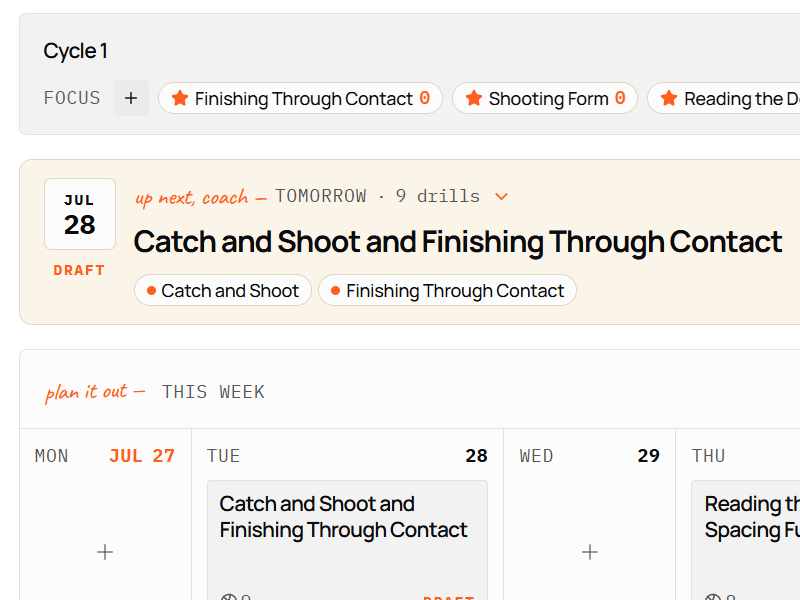
Relyx connects long-term development goals to short training cycles, then carries those priorities into individual practices. Enough structure to stay intentional, without pretending an entire season can be predicted in advance.
It looks like this:
In this guide you’ll work through the full skill framework, set targets and pick out the priorities that matter most, spread them across your training cycles, and carry them into weekly practices.
Why cycles?
Trying to improve everything at once produces disconnected practices. A cycle narrows the team’s attention for a few weeks so a skill gets enough repetitions to actually move.
Say your season runs thirty weeks and you’ve marked ten priorities. Spreading all ten across every week gives each one a few scattered minutes and no traction. Grouping them instead gives you something like:
- Weeks 1 to 3. Close out and on-ball defense.
- Weeks 4 to 6. Transition offense and finishing through contact.
- Weeks 7 to 10. Off-ball screens and shot creation.
Inside a cycle the practices still differ from each other, but they keep circling the same small group of skills. Players meet the same ideas repeatedly, in different contexts, which is what makes them stick. That’s the whole argument for periodization, and basketball season planning makes it in full.
Review at the end of each cycle rather than treating this as a fixed sequence. What the team needs in week seven depends on what actually happened in weeks one to six.
Relyx uses cycles as short training blocks, usually two to four weeks. Long enough to come back to an idea several times, short enough to adjust when the team needs something else.
1. Set your season goals
Open Skills for the active season. Relyx gives you the skill framework; your job is to say what you want from each skill and which ones matter most.
Ask:
- What should players at this age be learning now?
- What repeatedly breaks down in games?
- Which skills would unlock several other parts of our play?
- What does the club expect this team to develop?
- Which strengths should we keep building?
Then open the Development Guide for a second opinion. It shows typical targets for your age group. If you coach inside a Relyx Club, you’ll see your club’s own framework here instead, with the targets and coaching language your staff already agreed on.
The guide is there to inform your judgment, not replace it.
Target level
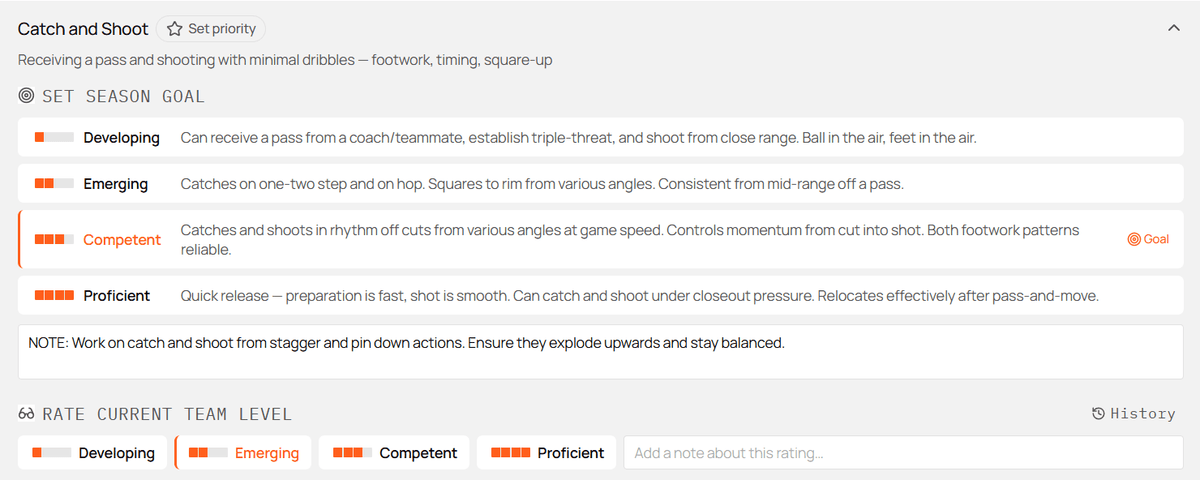
Open a skill and you’ll see four levels, each described in plain language: Developing, Emerging, Competent, and Proficient. Under Set season goal, pick the one you want the team to reach by the end of the season.
Add a note where the level description alone doesn’t say enough. The levels are shared language, but what “competent at catch and shoot” means for your U14 group in your league is yours to define, and next season’s you will be glad it’s written down.
Current level
Under Rate current team level, record where the team is now, for every skill you’ve set a target on.
This is the first step of a loop you’ll run all season: observe, plan, execute, observe again. You watch the team, you set the plan around what you saw, you coach it, and then you look again to find out whether it worked. The rating is what makes the last step possible, because “I think they got better” is not something you can compare against anything.
Rate on evidence from several practices or games. One good day or one bad day shouldn’t set the level. Each rating takes its own note, which is where the evidence goes, and History shows how the rating has moved across the season.
Rating everything also shows you the gaps. The distance between current level and target is often the clearest signal of what to work on first.
Priority
Set priority stars a goal as one of the few that must not slip. Goals and priorities are both visible all year; the difference is emphasis. A priority is what you’d protect if the season got compressed, the games piled up, and something had to give.
For the number, let the calendar decide. Roughly one priority per cycle is a good starting point, or about one for every four to eight practices. A 30-week season with 8 cycles supports around 10 priorities properly. It does not support twenty.
That constraint is the useful part. It forces the question of what actually matters this year, instead of leaving you with a list that describes everything and commits to nothing.
2. Lay out the cycles
Open Plan. The timeline shows the season divided into cycles.
If Relyx generated those cycles during setup, check the dates against your real calendar. Use Manage Cycles to rename a cycle, change its dates, add or remove one, or fill a gap.
Look at what the calendar is going to do to you before you assign anything:
- Holidays and school breaks.
- Tournament periods.
- Weeks with fewer practices.
- Pre-season preparation.
- Important competition phases.
A cycle doesn’t need a clever name. “Cycle 2” is fine. But something like “Paint pressure and kick-outs” makes the intent easier for the whole staff to remember.
Fill in Goal Coverage
The Goal Coverage table connects your season goals to those cycles. Click a cell to mark that a skill gets deliberate attention in that cycle. The Priorities, Goals, and All tabs change how much of the framework you’re looking at; start on Priorities, since those are the ones that have to fit.
On a first pass, aim to touch every priority at least once. That alone tells you whether your plan is realistic: if you can’t fit them all in, you have more priorities than season, and it’s better to find that out in September than in March.
Then refine. Three questions help:
- What does the team most need next?
- Which skills fit together naturally?
- What do we need to learn first to be ready for the games ahead?
Related skills make a coherent cycle. For example:
- Beating the defender.
- Finishing through contact.
- Penetrate and kick.
Or:
- Setting screens.
- Using off-ball screens.
- Catch and shoot.
Resist filling every cell. The table is valuable when it shows you choices, gaps, and repetition. You’ll come back to it as the season goes on, and it should change when the team does.
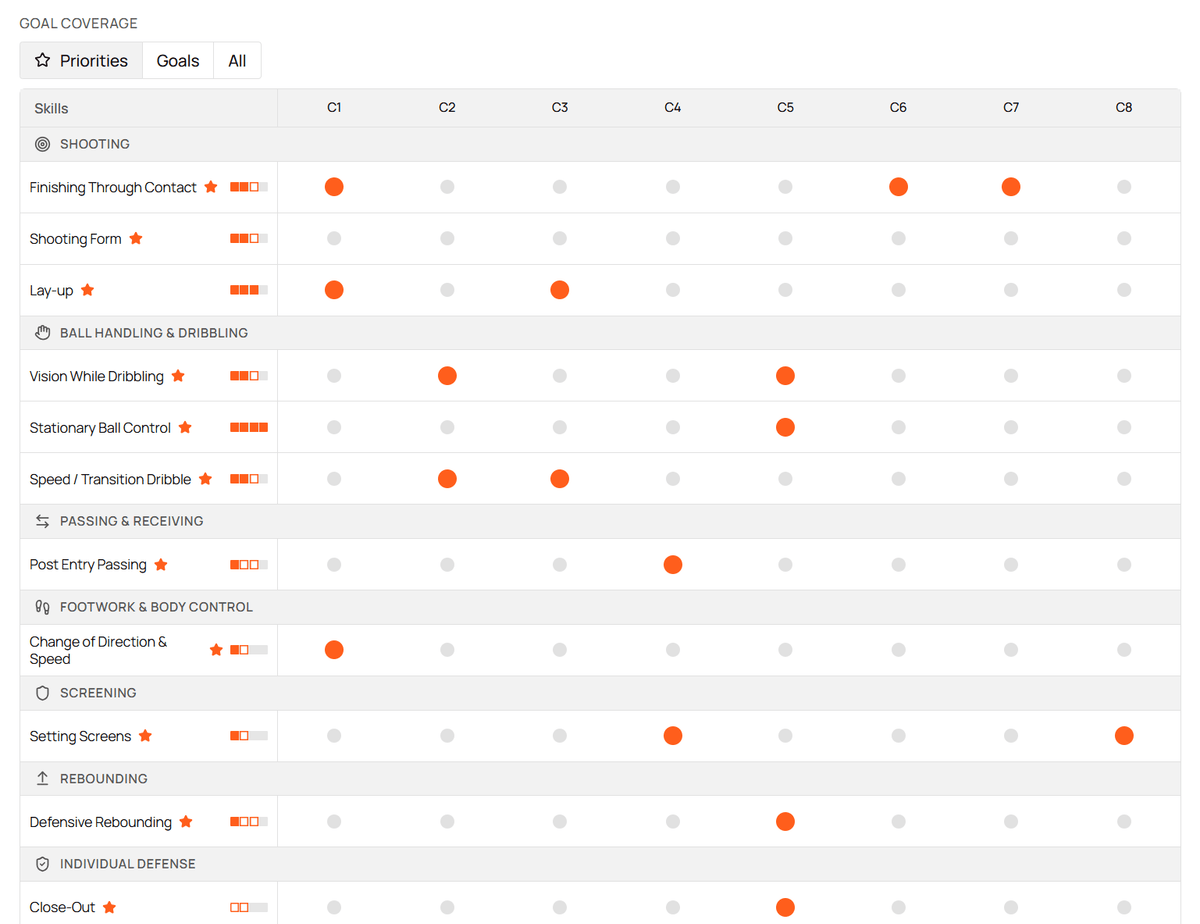
Read it across a row to see when a skill gets attention, and down a column to see what a given cycle is carrying. A row with no marks is a goal you haven’t planned for yet. A column with too many is a cycle trying to do everything.
3. Carry the cycle into practice planning
When you create a practice, assign it to the relevant season and cycle.
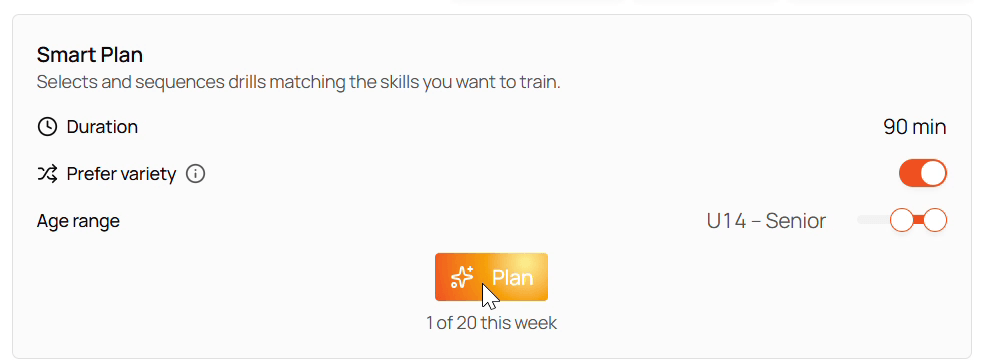
In the practice editor you can add skills directly under Skills to train, pull the current focus in with Suggest from cycle, or leave it empty and let Smart Plan prefer the cycle focuses.
A practice doesn’t have to give equal time to every cycle focus. What matters is that the skill keeps coming back, and that players are applying it, not just drilling it in isolation. Across a cycle you want repeated exposure in game-like conditions, with the difficulty and the decisions rising as the team gets more comfortable.
Relyx keeps the shared focus visible while letting each practice have its own purpose.
4. Review and adjust
At the end of a cycle, use the Plan page to see which goals got attention and where the gaps are. Then ask:
- Did the team get enough meaningful exposure to the focus?
- Has the team’s current level actually changed?
- Should this skill continue into the next cycle?
- What’s the most important problem now?
Then update the ratings where the evidence changed, set the next cycle’s focus, fix future cycle dates if the calendar moved, and revise priorities if the team’s needs have shifted.
That’s the loop closing: you observed, you planned, you coached it, and now you’re observing again with something concrete to compare against.
A season plan should change to ensure it stays connected to what actually happened.
Common mistakes
Setting goals without rating the current level
The target on its own doesn’t tell you what to do first. The gap does.
Making every goal a priority
If everything is starred, nothing is. Size the list to your cycles.
Assigning every goal to every cycle
Coverage isn’t focus. Concentrated work now beats touching everything superficially.
Treating the Development Guide as a requirement
It’s a reference point. Your team, your competition, your coaching philosophy, and the practice time you actually have all still matter.
Never revisiting the plan
Review at cycle boundaries. A plan becomes useful the moment it starts responding to evidence.